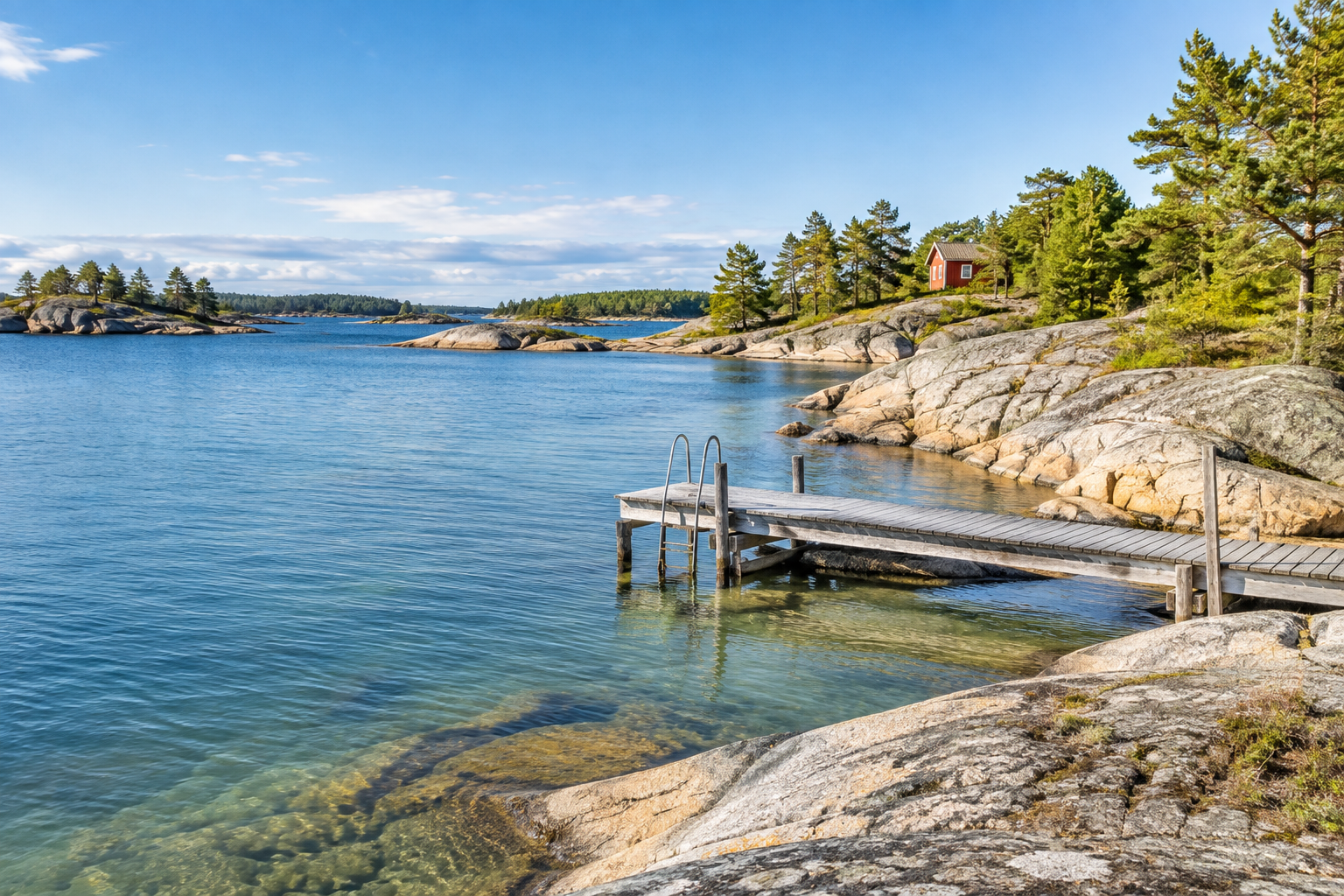
A swimming ladder disappears into blue water. A shirt dries on a cabin railing. There is still enough light after dinner to go for a walk, and a sweater becomes useful on the way home. This is another version of the European summer: less concerned with finding the hottest place on the map, more interested in a day that feels good to inhabit. The coolcation gives that desire a name. The question is how far it is changing the holiday itself.
When pleasant becomes the priority
A coolcation is a holiday chosen, at least partly, for milder temperatures. Its appeal is easy to understand without turning every traveller into a climate statistic. Walking, sleeping, eating outdoors and spending time with children all feel different when heat does not organise the entire day. The promise is practical, but also emotional: a little more freedom to do what you came for. Northern Europe offers a compelling setting for that idea, from an island stay to a city break built around water, parks and long summer evenings.
What September’s data tells us
On 16 September 2026, Copernicus reported that the June–August period had tied 2024 as the warmest globally in its record. Western Europe experienced its hottest summer in the dataset, while Europe as a whole ranked third. The regional detail matters: its August analysis found slightly below-average temperatures across northern Europe, from Iceland to Fennoscandia and the Baltic countries. These are observations of one season, not a forecast for your next holiday. They nevertheless explain why the promise of a milder summer feels timely. Weather is increasingly part of the destination’s appeal, rather than something checked only after booking.
Interest is turning into bookings
There are commercial signals too. In July 2026, the Financial Times reported Trivago figures showing UK bookings for July and August up year on year by 55% for Norway, 57% for Sweden and 29% for Denmark. That is a specific platform and source market, not a count of all European holidays. It supports a narrower, useful conclusion: Nordic summer travel is attracting stronger demand in at least part of the market.
The Mediterranean still has its summer
The broader picture resists a simple north-versus-south story. In its 2 July 2026 release, the European Travel Commission said Southern and Mediterranean Europe attracted 61% of intended travellers for the coming travel period, four percentage points more than a year earlier. In the same survey, 76% said climate-related factors influenced their travel behaviour; among those adapting their plans, 16% sought milder destinations. These are intentions, not completed journeys. Together, they suggest room for both a continued love of southern Europe and a more deliberate approach to temperature.
A new release is not a full summer verdict
Eurostat’s 1 September 2026 tourism release adds another useful boundary. EU accommodation recorded 1.321 billion overnight stays in the first half of the year, up 1.7% from the same period in 2025. Ireland, Malta and Slovakia showed the largest percentage increases. That is not a uniform movement north, and January–June figures cannot settle what happened across July and August. The September publication date makes the information new; it does not make it a complete account of the summer. The coolcation story is strongest when the dates and the measurements stay attached to the numbers.
The Nordic appeal is more than a thermometer
Imagine a summer arranged around a Stockholm archipelago ferry, a Finnish lakeside cabin or a Copenhagen afternoon that ends beside the harbour. Each offers a different relationship with water, daylight and movement. The appeal is not simply a lower temperature. It is the possibility of giving ordinary pleasures more space: coffee outside, a swim, a long conversation, another hour of walking. This is our reading of why the Nordic setting suits the coolcation idea so well. The landscape provides the picture, but the rhythm is what makes someone want to step into it.
A different picture of summer
The visual language changes too. Pale rock instead of a row of beach loungers. A wooden jetty instead of a hotel pool. A light jacket folded beside a picnic. These images make northern summer easy to imagine as a desirable holiday in its own right. They also risk turning a whole region into another interchangeable mood board. A harbour neighbourhood, a working coastal village and a remote cabin offer very different experiences. The better question is what you want your days to contain. Quiet, culture, swimming and good food do not always require the same destination—or the same itinerary.
Cooler still requires a little planning
Choose the place and month together. A city stay with museums and cafés can absorb a rainy afternoon differently from a trip built around boat crossings and exposed trails. Look at local weather patterns, transport connections and the practicalities of the accommodation before deciding. Leave room for conditions to change. A northern address does not guarantee mild weather, solitude or a lower bill. Nor does travelling somewhere cool automatically make the journey environmentally light: how you get there, how far you move around and how long you stay remain part of the decision.
The luxury of a comfortable day
So, is the coolcation becoming the new European summer? It is becoming a more persuasive version of it. The evidence points to growing interest in milder destinations alongside enduring demand for the Mediterranean. What feels culturally interesting is the permission to want something different from a summer holiday: enough warmth to sit outside, enough energy to keep walking, enough space in the day to notice where you are. A Nordic summer can make that feel beautifully ordinary. Perhaps the most desirable forecast is simply one that lets you enjoy being there.
Sources
- Copernicus — Climate update, published 16 September 2026
- Copernicus — August and summer 2026 regional temperature analysis
- Eurostat — First-half 2026 tourism nights, published 1 September 2026
- European Travel Commission — Travel sentiment, 2 July 2026
- Financial Times — Nordic coolcation demand, 24 July 2026
On slow travel, quiet cities and places that reward attention.