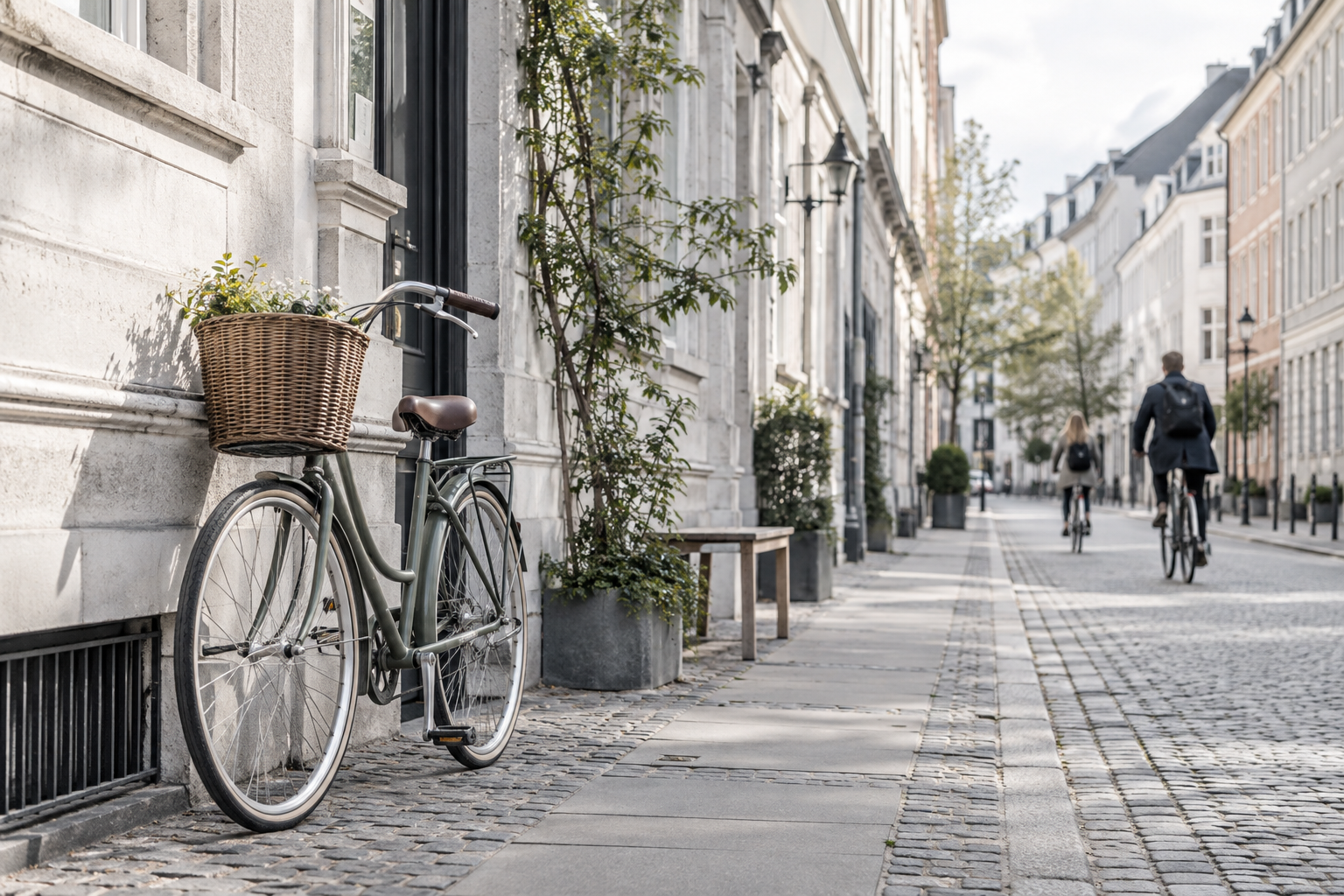
Imagine a short journey with no search for a parking space at the other end. A bag in the basket, a familiar turn, a stop for bread on the way home. The appeal of going by bike can be remarkably ordinary. For a journal interested in how design enters daily life, that ordinariness is the story: the street, the crossing and the place to leave a bicycle all help determine how freely a day can unfold.
An everyday journey, counted
Copenhagen gives this image a measurable foundation. The city’s Mobility Report 2026 records cycling as 47% of residents’ journeys to work or education in 2025. Among residents whose work or study was also within the municipality, the figure was 55%. These are shares of journeys for specific groups, rather than percentages of all people who cycle. Walking also mattered: it represented 32% of residents’ trips overall. The numbers describe a city where moving under your own power has a substantial place in everyday transport.
The design is in the route
Copenhagen describes its cycling strategy in terms of making riding attractive, safe and fast. Its report also records unfinished work: the broader target for cycling to work or education in the city was missed in 2025. Even a well-established cycling city has gaps. For the rider, useful infrastructure becomes tangible at small moments: a route that continues through a junction, enough room to pass, somewhere convenient to lock up. Our reading is that these details deserve the same attention we give a beautifully designed building. They shape whether an ordinary journey feels manageable.
Stockholm adds a different perspective
The Nordic region has no single transport habit. Region Stockholm’s 2024 travel survey put cars at 41% of residents’ journeys, public transport at 36%, walking at 13% and cycling at 8%. Its central-area residents made a smaller share of journeys by car than those in outer suburban municipalities. This is regional evidence, not a description of every street in central Stockholm, and the survey differs from Copenhagen’s. The contrast helps explain why a photograph of bicycles cannot stand in for a whole country. Where someone lives, how far they travel and the alternatives available all belong in the picture.
Sustainability that fits the day
Travel figures tell us what people do; they do not establish that environmental concern is everyone’s main reason for doing it. A convenient journey can have several attractions at once. Time, cost, comfort and the possibility of stopping along the way are useful questions to ask alongside emissions. The editorial lesson we draw is practical: sustainable transport becomes more convincing when it works within real routines. A parent carrying shopping, a person with limited mobility and a commuter travelling across a region may need very different options. A good conversation about cycling leaves room for those differences.
A bike belongs in a wider system
A current proposal in Oslo makes that wider view explicit. In June 2026, the city government presented a green mobility plan for public consultation, bringing walking, cycling, public transport and commercial transport into the same discussion. It proposed that 85% of journeys take place on foot, by bicycle or by public transport. That is a proposed target, not an achieved result. The announcement connected the plan with safer neighbourhoods, public health and reduced congestion and pollution, while recognising different conditions in inner and outer areas. The useful idea is choice across a network: a bicycle can be one part of getting around, alongside other ways of travelling.
Seeing a place between destinations
There is also a more personal reason to give the journey attention. At bicycle pace, the space between appointments can become part of the day: noticing a courtyard, recognising a shop window, feeling the weather change. These are possibilities rather than promises. Rain, darkness, distance, confidence and accessibility can all change the experience. As a visitor, choose a route that suits your ability, learn local cycling rules and stop safely before checking directions. Walking or taking public transport can be the better choice for a particular outing. The pleasure lies in finding a way through the city that works for you.
Freedom, at the scale of an ordinary day
The most compelling image of Nordic cycling may be a bicycle waiting outside somewhere entirely unremarkable. Someone has gone inside to work, collect something or meet a friend. We see an everyday object; behind it sits a much larger set of decisions about streets, access and public space. That is what makes this subject worth noticing. A city’s design reaches into the small choices that fill a day, including the simple possibility of getting somewhere under your own power. for those who notice.
Sources
On slow travel, quiet cities and places that reward attention.