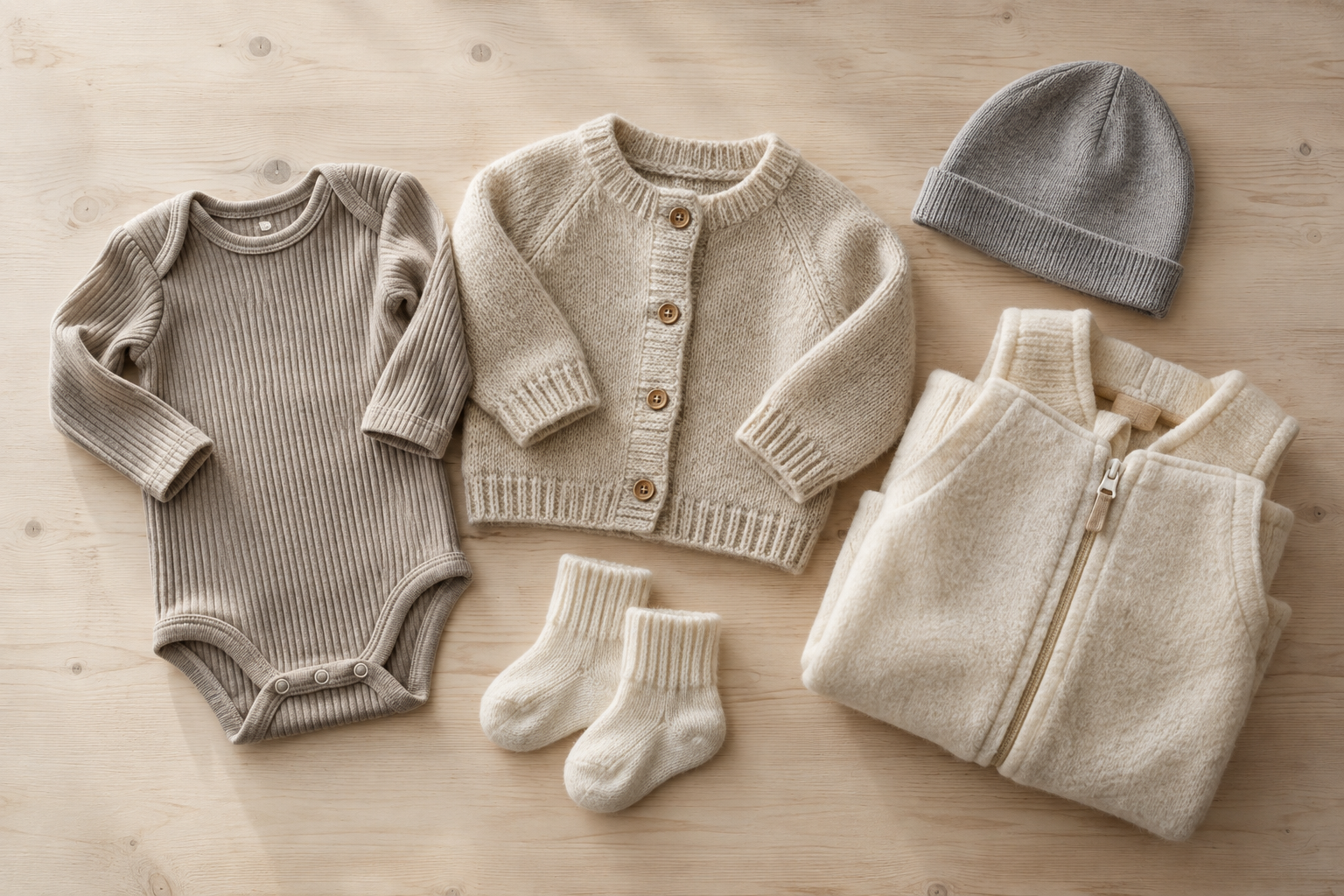
A tiny wool cardigan, a pair of soft socks, a winter overall waiting by the door. Baby clothes make everyday design unusually tangible: fabric meets sensitive skin, a fastening is opened several times a day, and each piece soon has to accommodate a growing body. The Nordic baby wardrobe is an interesting place to look at those decisions. Drawing on Finnish and Swedish examples, this edit explores clothing shaped by weather and use, with room for texture, colour and the pleasure of dressing someone very small.
Start with the baby, then the weather
There is no single outfit that works across a Nordic winter. Sweden’s public health service, 1177, frames outdoor clothing around age, activity and local conditions. A baby lying still in a pram has different needs from a child running around. Its guidance favours adjustable layers and notes that very young babies have difficulty regulating temperature. It also advises keeping newborns indoors in very cold, windy conditions. For this wardrobe, the useful starting point is adaptability: pieces that can be changed as the surroundings change, with advice from the baby’s healthcare professional when needed.
The first pieces do the most work
Finland’s maternity package offers a concrete example of a baby wardrobe assembled around everyday needs. The 2025 edition listed by Kela includes wrap-around bodysuits, some with extenders, trousers, socks, mittens and a wool cap. These small details deserve attention. A wrap opening changes the way a garment goes on; an extender builds adjustment into a piece that will be outgrown. For our edit, we would look closely at how a bodysuit opens, how the seams feel and whether its care instructions fit the household’s routine. The beauty of a basic is often in how easily it earns its place in the wash again.
Wool belongs in the conversation
1177 identifies wool as an example of a material that can provide warmth while helping keep skin dry in cold weather. That gives a wool layer a practical role alongside its visual appeal. A fine rib, a soft cuff or a simple knit can bring texture without elaborate decoration. Material names alone are not enough to choose a garment, however. Our editorial checklist would include the fibre composition, feel, fit and washing requirements. A beautiful knit needs to work for the particular baby wearing it and the person caring for it.
Outerwear is a design object with a job
Kela’s 2025 snowsuit is also designed to convert into a bag shape. Supplied by Reima, it combines a windproof polyester exterior with a cotton lining and a zip fastening. Its dark grey Moomin pattern is a useful reminder that practical Nordic baby clothing can have personality. The interesting detail here is the combination of construction and purpose. When considering an overall for outdoor use, look beyond its photograph to its intended use, sizing and manufacturer’s instructions. A product described as a snowsuit or outdoor bag should not be assumed to be interchangeable with indoor infant sleepwear.
Small accessories, considered together
Caps, mittens and booties complete the outdoor picture, but the baby’s clothing needs to be considered as a whole. More pieces do not automatically mean greater comfort. 1177 emphasises adjusting clothing when moving indoors. For the visual edit, we would keep the shapes simple and let the fabrics provide variation: a ribbed hat, a smooth overall, a pair of knitted socks. Cream and soft grey can sit beside muted blue or a playful print. This is our styling interpretation, rather than a claim that all Nordic families dress their babies in a particular palette.
The outdoor nap is context, not a clothing formula
The images of babies napping outside are connected to a real practice. A 2008 study surveyed 116 parents using child welfare clinics in Oulu, Finland, about outdoor winter sleep. It documented a local tradition and parents’ experiences, including concerns related to cold and overheating. The authors called for further objective research before guidance could be updated. This is evidence of a cultural practice, not proof that outdoor sleep is safer or a recommendation to recreate it. No outfit makes an outdoor nap automatically safe. Families considering it should consult their baby’s healthcare professional and follow local infant-sleep guidance.
Indoor sleep needs its own wardrobe
The distinction between outdoor clothing and sleepwear matters. Health Canada recommends simple, properly fitted sleepwear appropriate to the room temperature, removing outerwear once indoors and avoiding indoor hats because of overheating. Its guidance also warns against weighted sleep products. A photograph of an outdoor outfit cannot tell you what is appropriate for sleep. Keep the two decisions separate and use current infant-sleep guidance for the place where you live. The clothing in this edit is a starting point for understanding design and everyday use, not a prescribed sleep setup.
A small wardrobe with a clear purpose
There is something appealing about baby clothes that feel considered at this scale: an opening in the right place, a cuff that feels gentle, a garment whose instructions are easy to understand. Begin with the pieces your baby actually uses and let the wardrobe grow around those needs. A favourite colour or a small pattern can supply all the expression it needs. The Nordic references here offer a way to look more closely at ordinary objects and the care built into choosing them. That is where this wardrobe becomes personal. for those who notice.
Sources
- 1177 · Dressing young children for outdoor conditions (Swedish)
- Kela · Maternity package, 2025 edition
- Kela · Snowsuit design, materials and supplier
- Tourula, Isola and Hassi (2008) · Parents’ experiences of outdoor winter sleep in Oulu
- Health Canada · Dressing your baby for sleep
Image: AI-generated editorial illustration. The garments are illustrative and do not depict the specific products discussed.
Explore more stories about Nordic materials, useful objects and daily rituals in the Journal.