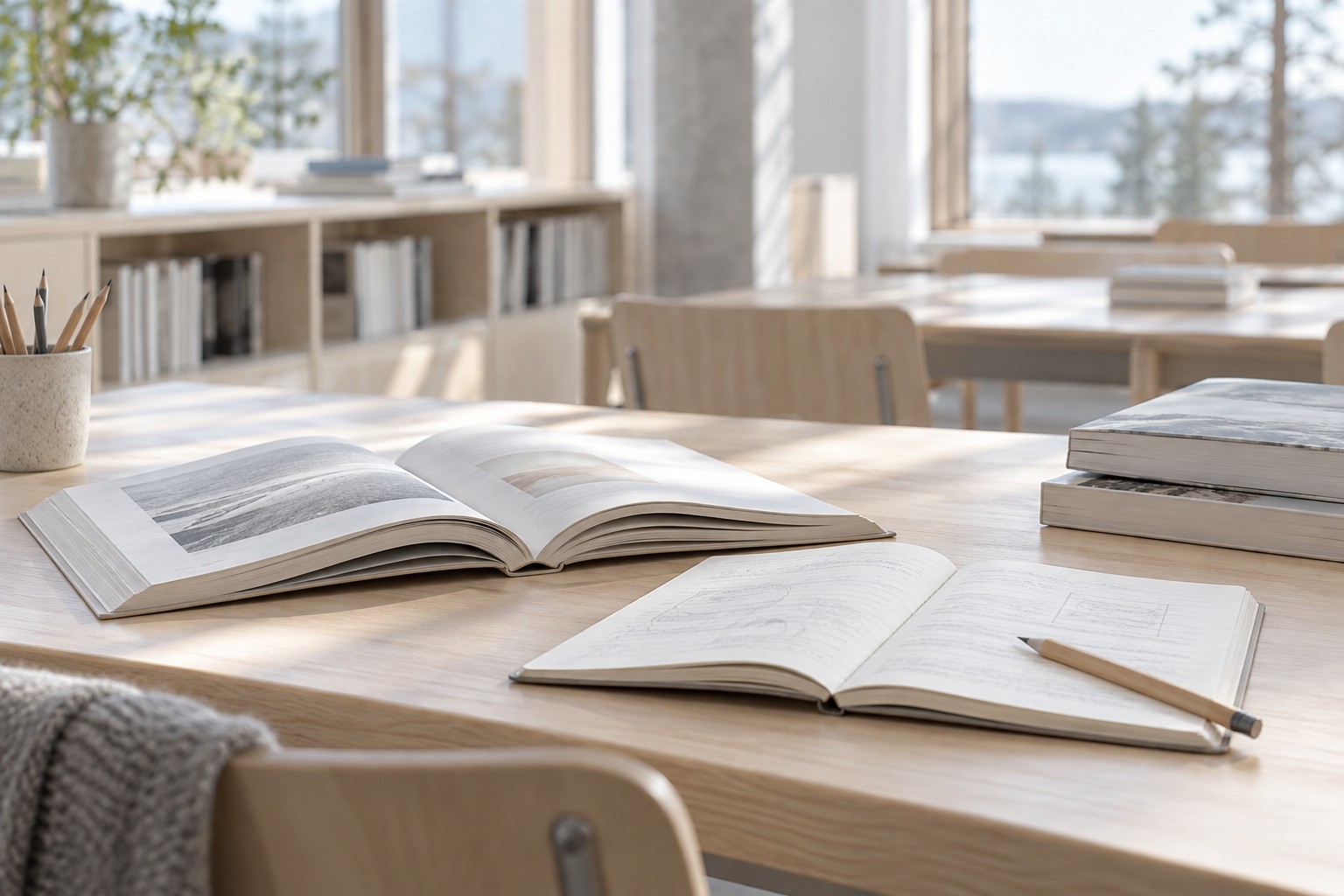
A printed book asks for a different kind of attention. There is no battery to check, no notification at the edge of the page and no second tab waiting behind the first. That does not make paper automatically better than every digital tool. It does explain why several Nordic governments are reconsidering the balance between the two, particularly in schools. The result is not a nostalgic rejection of technology. It is a more interesting question: what still works best on paper?
The shift is real, but it is specific
The clearest evidence comes from education policy. Sweden has invested in physical textbooks, literature and staffed school libraries while arguing that digital learning tools should be introduced when they support, rather than hinder, learning. In Norway, the government proposed in June 2026 that access to printed learning materials should be guaranteed in primary and lower secondary schools. Denmark has allocated DKK 540 million from 2025 to 2034 for more physical books in public schools. These are significant decisions, but they do not mean that Nordic countries are abandoning digital education. They show a deliberate attempt to restore choice and rebalance classrooms after years of rapid digitalisation.
Sweden is treating reading as infrastructure
Sweden’s current approach goes beyond replacing one device with one textbook. Government measures include funding for textbooks and fiction, stronger access to staffed school libraries and a national reading strategy for 2026 to 2031. The strategy responds to a wider concern about reading comprehension among children and young people. That context matters. Paper is not being presented simply as a beautiful object; it is part of a system that also needs teachers, librarians, appropriate titles and time to read. The physical book is visible, but the culture around it does much of the work.
Norway wants teachers to have a real choice
Norway’s June 2026 proposal is especially useful because it frames the issue as access. The government said many teachers do not feel they can genuinely choose between printed and digital materials, and proposed making printed resources available by law. It also pointed to more than NOK 500 million already prioritised for physical textbooks. At the time of publication, this was a government proposal rather than a confirmed legal requirement. Still, the principle is clear: a balanced classroom needs both formats to be practical options, not one format in theory and another by default.
Denmark is putting books back into circulation
Denmark offers another version of the same conversation. Its school quality programme set aside DKK 540 million for physical books over ten years. A revised funding model announced in late 2025 directed 70.2% of the relevant allocation to buying books and was expected to increase the number purchased through the lending system. The model also funds circulation between schools, allowing the same title to reach several groups of pupils. That detail makes the story more than an analogue aesthetic. It is about access, selection and the practical design of a shared resource.
Paper changes the shape of attention
A page gives information a fixed place. A note can sit in the margin; a passage can be found partly because you remember where it appeared. Writing by hand also introduces a useful slowness. These qualities may support concentration, but the Nordic policy documents do not prove that every person learns better from every printed page. Age, accessibility, subject and individual need all matter. Digital tools can enlarge text, provide audio, support translation and make information easier to update. The strongest case for paper is not that it should replace everything. It is that its particular qualities should not disappear through convenience alone.
What belongs on paper in an adult life?
Outside the classroom, the decision becomes personal. A novel might deserve paper because you want an evening without another illuminated screen. A notebook might be useful for thoughts that are not ready to be organised. A travel guide, exhibition catalogue or cookbook may become an object you return to as much for memory as for information. Other things are better digital: a ticket that changes, a map that needs live directions, a document shared by several people. The useful question is not whether paper or digital wins. It is what kind of attention the task deserves.
The bookshop is part of the experience
This renewed interest also gives independent bookshops a natural place in the Nordic Way My Way world. Stockholm alone offers different ways into print: Konst-ig specialises in art and visual culture; Papercut brings together books, magazines and other printed matter; Rönnells Antikvariat has been part of the city’s literary landscape since 1929. A future edit could move from the policy story to the pleasure of discovery, linking books about Nordic design, architecture, food and cities with the shops where readers encounter them. The value is not only in owning a title. It is in browsing without already knowing what you are looking for.
A place for paper, chosen with intention
The Nordic case for paper is not really a case against modern life. It is a reminder that progress can include bringing something back when its absence becomes visible. A physical book creates a boundary around a text. A notebook leaves room for an unfinished thought. A library makes reading available beyond the ability to buy. The new Nordic policies are rooted in education, but the question travels easily into everyday life: which parts of your day become richer when they have weight, texture and a page you can turn? for those who notice.
Sources
- Government Offices of Sweden · More reading time and less screen time, updated March 2025
- Government Offices of Sweden · A Reading Country, national reading strategy 2026–2031
- Government of Norway · Proposal to guarantee access to printed learning materials, June 2026
- Danish Ministry of Children and Education · Funding for physical schoolbooks, November 2025
- Visit Stockholm · Guide to independent bookshops in Stockholm
On books, attention and making space for a slower kind of evening.