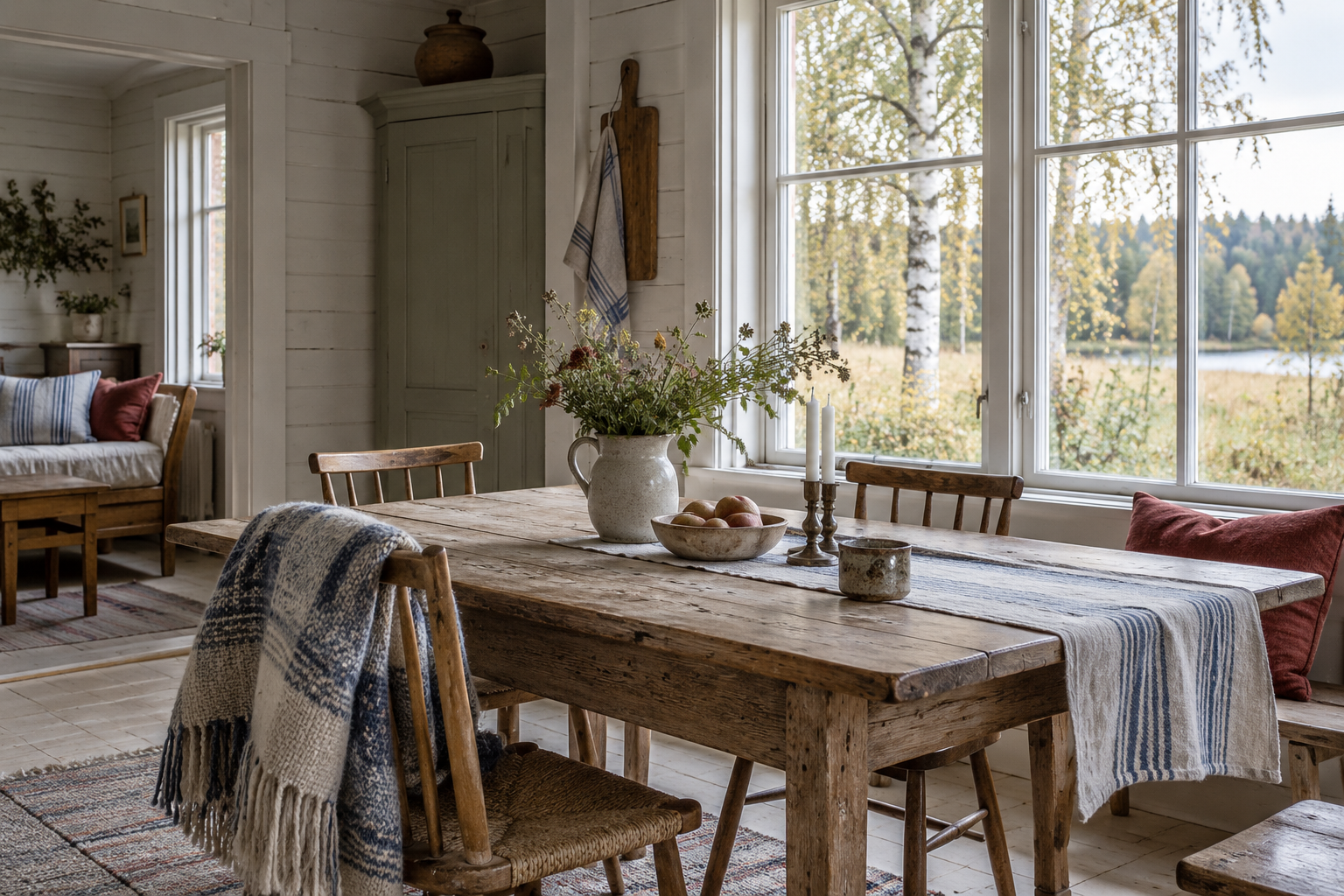
The room begins at the door: somewhere to put a coat, a chair pulled towards the window, a table with enough space for breakfast and whatever happens afterwards. A country house feels welcoming when these small arrangements make sense. For our Nordic country-house edit, the starting points are particular homes and design traditions in Sweden, Finland and Denmark. They offer different answers to the same question: how does an interior become a place you want to return to?
Useful rooms make room for life
Start with the actions a room needs to accommodate. Wet shoes need a landing place. Reading requires a comfortable seat and useful light. A table might hold lunch, a puzzle and a notebook in the same afternoon. At Lilla Hyttnäs, Carl and Karin Larsson’s home in Sundborn, the house’s own account describes distinct spaces for making, reading, conversation and meals. The lesson we take from this is less about the number of rooms than their purpose. A corner can be enough when its chair, surface and storage support the way someone actually spends time there.
Let the landscape set the starting point
Alvar and Elissa Aalto’s Muuratsalo Experimental House offers a striking Finnish reference. Built in the 1950s beside Lake Päijänne, their summer home brings white plaster, red brick and ceramic surfaces into an enclosed courtyard, while much of the surrounding site remains natural. Its walls contain around fifty experimental panels of different bricks and tiles. This is a specific architect’s home rather than a template for all Nordic houses. What makes it useful here is the conversation between a deliberately composed interior world and an irregular landscape. At home, begin by noticing the view, the direction of daylight and the materials already present before choosing a new palette.
Wood should suit the work it does
A timber table can bring warmth through grain and touch, but a beautiful surface still has to cope with the household using it. Consider its finish, care requirements, stability and the possibility of repair. Fritz Hansen’s current description of the Skagerak Collection places material choice and repairability at the centre of longevity, connecting contemporary furniture with Danish woodcraft traditions. That is a useful principle to carry beyond one brand. An existing table with a sound structure may already be the right piece. If buying, ask what maintenance involves and what can be repaired; natural material alone tells you little about how an object will perform over years.
Textiles can carry the personality
Karin Larsson’s work makes a strong case for allowing fabric to lead. The museum describes her textiles as combining folk traditions, Art Nouveau and Arts and Crafts influences, with expressive colours and motifs across cushions, curtains and wall hangings. For a contemporary room, that might translate into a striped curtain, a woven throw or one patterned cushion beside plain upholstery. These are our editorial suggestions, not historical reproductions. Choose a fabric for its touch and its task: how much light it admits, whether it can be washed, and whether it feels comfortable against skin. Pattern becomes more convincing when the object gets used.
Colour belongs in the country house
Lilla Hyttnäs also challenges the idea of one pale palette. Its dining room combines green and red-orange, while other rooms use lighter Gustavian colours. There is room to take inspiration from that confidence without copying a historic interior. Try one painted chair, a blue textile or a deeper red on a small surface, then consider how it sits beside the timber and the view. The amount of colour can remain modest. A home gains character through relationships between objects, and a familiar piece does not need to match everything around it to belong.
Choose light from the seated position
The Danish PH 5 pendant provides a practical design reference. Louis Poulsen describes Poul Henningsen’s layered shade system as a way of creating soft, glare-free light. The idea matters more here than the particular lamp: look at where the light goes and what your eyes meet when you sit down. A pendant over a table, a reading lamp beside a chair and a smaller light near the entrance can serve different moments. Check brightness, shade position and dimming compatibility before buying. A lamp that looks elegant while switched off still needs to make the evening comfortable.
Familiar objects give a room its history
A jug that comes out every weekend, a bowl from a small pottery, books with folded bookmarks and a chair inherited from another home can make a room feel specific. Their value is personal. There is no requirement to assemble a perfectly coordinated country-house collection. Begin with what you own and what it makes possible. If a gap remains, a future addition might be as simple as a washable tablecloth, a useful tray or a throw kept within reach. These are categories worth considering individually, according to use, rather than a shopping list a home must complete.
A home that can change with the day
The most useful country-house ideas travel well into smaller homes and city apartments. Keep a view visible. Give a favourite activity a comfortable place. Make daily objects easy to reach, and leave enough space for someone to pull up another chair. The historic homes and contemporary design references here offer possibilities rather than a single Nordic formula. What makes them interesting is the attention paid to living: materials encountered by hand, fabric that softens a room, light that arrives where it is needed. Over time, a home becomes familiar through these repeated encounters. for those who notice.
Sources
Explore the home selection through the Nordic Way My Way lens.