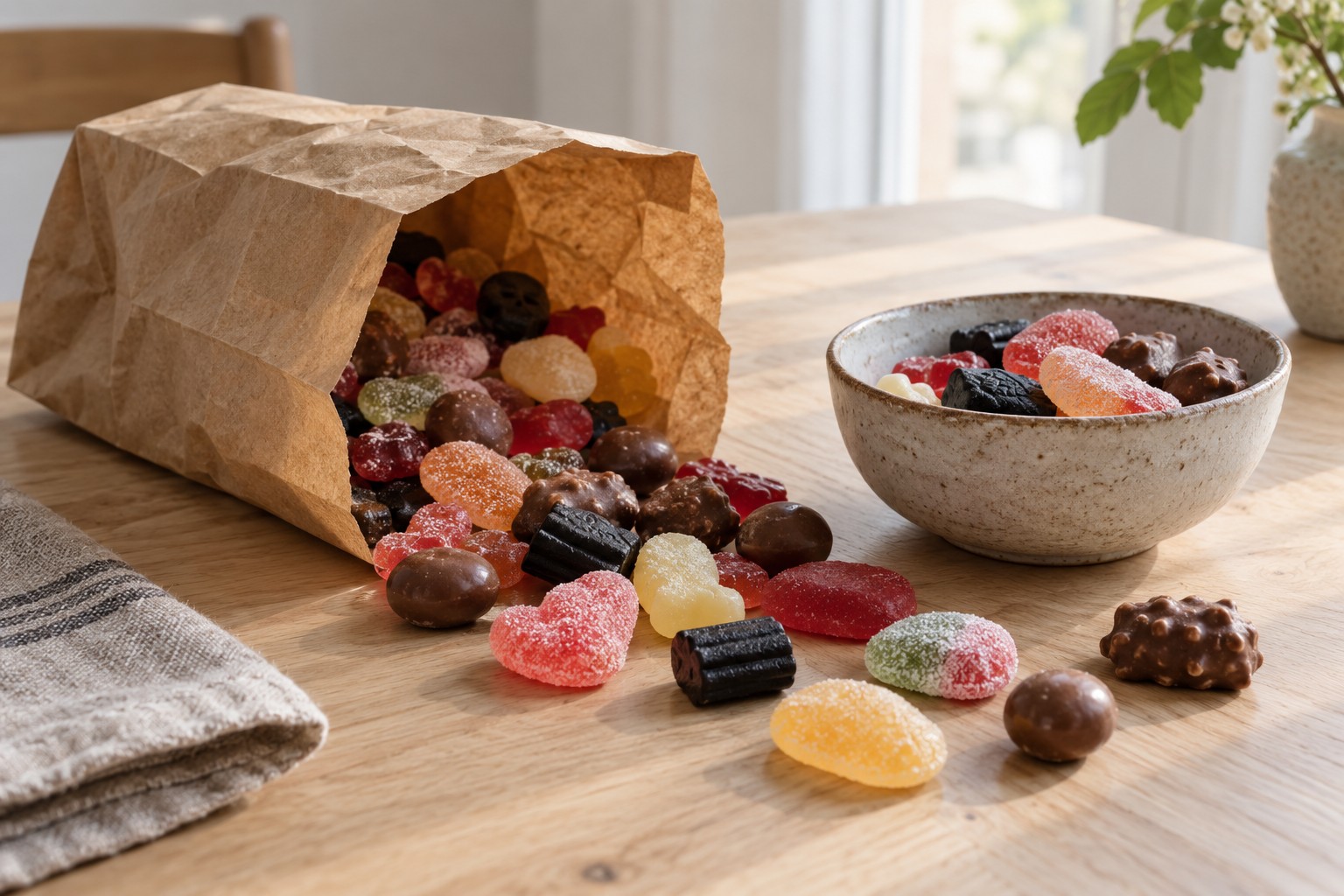
Imagine being given an empty paper bag and a wall of choices. Something sour, something chewy, a piece of chocolate and perhaps the liquorice someone else always leaves behind. In Sweden, this small decision has a familiar place in the week: Saturday. Lördagsgodis means Saturday sweets. Behind the cheerful name is a story that moves from public health campaigns to supermarket aisles, and from a weekly rule to a personal ritual.
A Saturday habit, rather than a national holiday
The name describes a recurring custom of saving sweets for Saturday. Visit Sweden traces the concept to the 1950s, when authorities recommended making sweets a once-a-week treat. It is a cultural tradition, not a ban on buying candy on other days, and it should not be read as a schedule followed identically by every Swedish household. Its most interesting feature is the calendar: an ordinary pleasure is given a particular moment to look forward to.
The history behind the cheerful bag
That public-health background includes a troubling chapter. Historian Elin Bommenel’s research documents dental experiments at Vipeholm, an institution in Lund for people with intellectual disabilities. In 1947, researchers began giving patients sweets to provoke tooth decay. Patients were harmed, and their treatment did not recognise them as autonomous research participants. Bommenel describes how the findings subsequently informed efforts to change sugar consumption, including a major public information campaign in 1957. Lund University’s later reporting records the serious dental damage suffered by some participants. This history belongs in an account of Saturday sweets. A familiar tradition can carry happy memories today while still requiring an honest account of the people harmed in the research behind its public-health context.
The ritual is also in the choosing
Visit Sweden describes pick-and-mix selections in supermarkets, kiosks and petrol stations. The format makes the bag personal: you choose the combination rather than accepting one decided for you. It also gives a visitor a small, everyday setting to explore. Our suggestion is to spend a little time looking before filling the bag. Which shapes do you recognise? Which flavours would you never have put together? A supermarket aisle can offer a different encounter with a place from a restaurant booking or a famous bakery.
There is more than one Swedish sweet tooth
Among the examples highlighted by Visit Sweden are Ahlgrens Bilar, the pastel car-shaped sweets, Dumle chocolate-covered toffee and salty liquorice such as Djungelvrål. These offer very different starting points. You do not need to enjoy every flavour to be curious about the selection. For a first tasting, we would choose a few familiar pieces alongside something new, rather than treating the entire display as a challenge. If you are choosing vegetarian or vegan sweets, check the ingredient information for each product instead of assuming that a fruit flavour means it is plant-based.
Why a weekly treat makes an interesting story
For us, the appeal of lördagsgodis lies in anticipation. Something ordinary becomes memorable when you know when it will happen and have a small choice within it. The bag, the walk home and the discussion about favourites can become as much a part of the occasion as the sweets themselves. That is an editorial reading of the ritual, rather than a claim about how every family experiences it. It is also why the idea travels well as a story: almost everyone understands having a favourite, saving it until last or discovering that someone else has eaten it.
Bring home the idea, in your own way
You do not need a perfectly styled table to borrow the social part of the ritual. Choose a modest selection you actually want, put it in a bowl you already own and make time to enjoy it with someone. If a paper bag on the sofa suits the evening better, that works too. The point of our interpretation is the shared occasion, not a new collection of things to buy. Nor should the tradition be treated as advice that an unlimited amount of candy becomes harmless simply because it is Saturday. This is a cultural story, not a dietary prescription.
A small detail with a longer story
So why does Sweden have a day for candy? The custom developed around advice to limit how often sweets were eaten, then became part of the rhythm of everyday life. Understanding it means holding more than one thing in view: the difficult history, the familiar routine and the individual choices inside each bag. For a visitor, it is a reminder that culture can be found in the most ordinary places. Sometimes the next detail worth noticing is waiting beside the supermarket checkout. for those who notice.
Sources
- Visit Sweden: Swedish food souvenirs and Saturday sweets
- Elin Bommenel: The Sugar Experiments, doctoral thesis (2006), Lund University publication record
- Lund University: Reporting on the Vipeholm dental experiments (2024, in Swedish)
Sources reviewed in October 2026. Serving and tasting suggestions are our editorial interpretation. Image: AI-generated editorial still life, not a photograph of the named products.
Discover more places, objects and cultural stories through our Swedish lens.