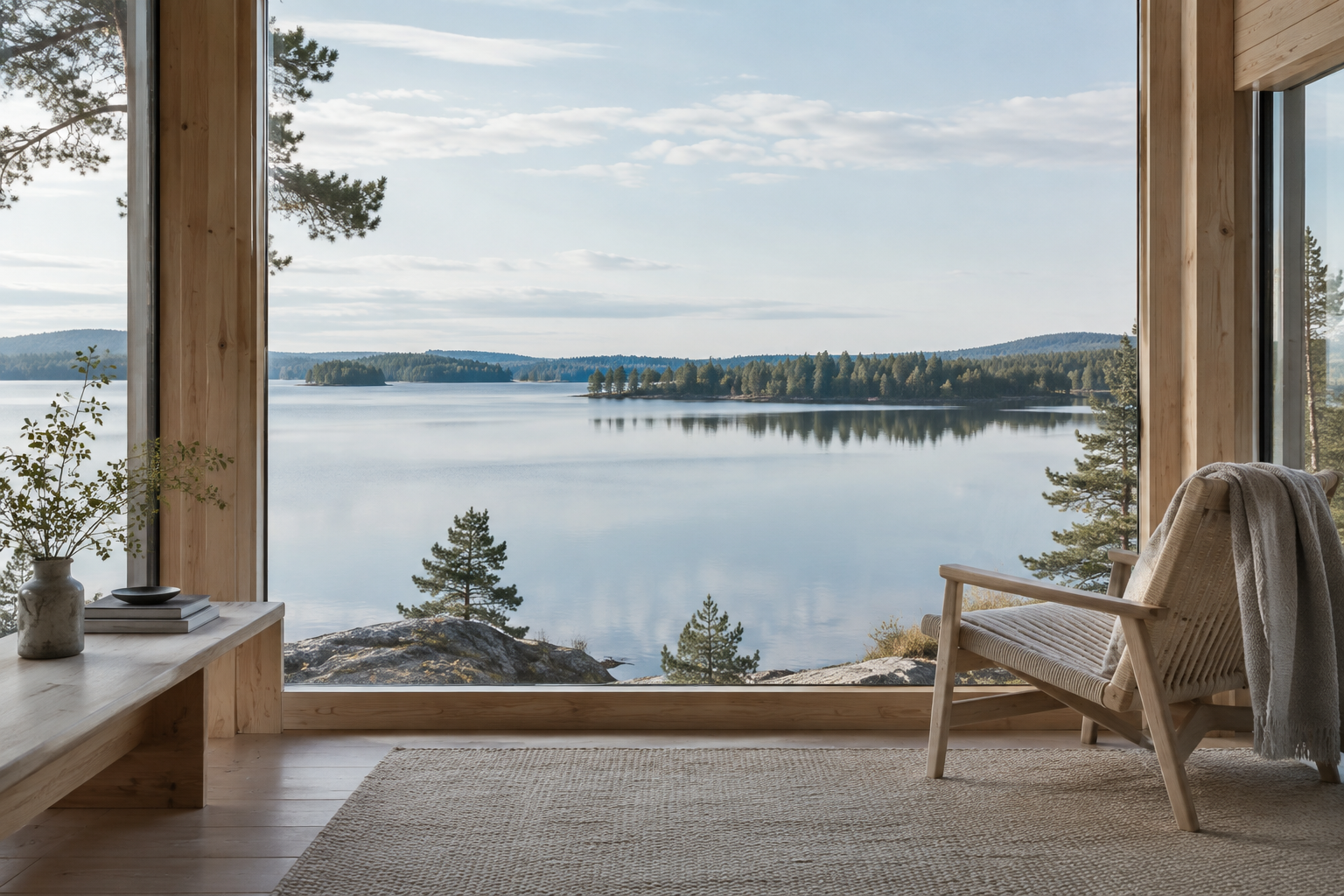
Imagine arriving somewhere and noticing what you can hear: water against a shore, a floorboard beneath your feet, wind moving through trees. For once, nothing needs an answer. The appeal is immediate, and slightly revealing. When a place can make the absence of interruption feel like its most desirable feature, luxury begins to mean something different. It becomes a question of what you are allowed to stop doing.
There was no single turning point
Silence did not suddenly become valuable in 2026. What feels newly visible is the way it is being packaged and promoted. In November 2025, Visit Sweden invited travellers to come and get bored, presenting an unhurried winter break as something to want. Its guide, updated in September 2026, continues that invitation. This is tourism positioning, rather than proof that everyone now wants the same holiday. Still, the proposition is telling: a destination can attract attention by promising to demand less of it.
A Swedish stay with a volume limit
This autumn, Visit Skåne gives that idea a particularly literal form. Its Stay Quiet initiative offers selected guests a free beachfront cabin stay on Sweden’s Baltic coast between 29 September and 16 October 2026, with a rule that indoor sound must remain below 45 decibels. The application deadline was 6 September, so this is a current cultural example, not an invitation to book. A monitored stay is a playful tourism experiment, not a clinical treatment or a model for how quietly everyone should live. Its interest lies in the premise: quiet itself is the attraction. The initiative follows the region’s Map of Quietude, launched in 2024, which pairs natural locations with sound measurements and recordings.
The noise behind the desire
There is a concrete backdrop to this appeal. The European Environment Agency’s Environmental Noise in Europe 2025 report, with corrections incorporated in March 2026, says more than one in five Europeans are exposed to harmful transport noise under EU reporting thresholds. It estimates that around 4.6 million people experience severe sleep disturbance associated with transport noise. Road traffic is the most widespread source. These findings concern environmental sound exposure. They do not measure notification fatigue, and they do not establish that a quiet weekend will reverse the effects of chronic noise. They do help explain why acoustic comfort deserves attention beyond the language of wellness.
The Finnish invitation to unplug
Visit Finland approaches the subject through familiar activities. Its current digital-detox guide suggests sauna visits, cottage stays, forest walks and time on the water. It also points towards calm within cities, including Helsinki’s Central Park and eastern archipelago. Read as a travel invitation, the message is appealingly ordinary: a change in attention can begin with what you choose to do for an hour. Finland’s example gives this story a different scale. The desired pause can fit into a day, rather than requiring an elaborate retreat.
Quiet has a sound of its own
The silence people imagine in a lakeside room is rarely the complete absence of sound. There may be rain, birds, footsteps or someone making coffee. Those sounds belong to the place. What feels luxurious is the possibility of hearing them without competing demands. That distinction changes what we look for in a stay. A beautiful view says little about road noise, a humming ventilation system or music from the restaurant below. The room’s soundscape deserves the same consideration as its light, bed and materials.
A room cannot be judged by its photograph
Before choosing somewhere for quiet, ask specific questions. Does the room face a road or courtyard? Is there an event space nearby? Are there shared areas where music plays throughout the day? Look for recent guest descriptions of sound, especially at the times you expect to rest. Inside a home, the equivalent is to listen before adding another object: which sounds are welcome, which can be reduced, and where can a conversation happen comfortably? A restrained interior may look peaceful while doing very little to protect it.
The uncomfortable part of calling it luxury
There is a tension in making quiet aspirational. If relief from noise becomes something people are expected to purchase, the people with the least choice over where they live or work can be left out of the picture. An expensive cabin is one response to the desire for quiet; a more liveable everyday environment is a larger ambition. Our reading of these Nordic examples is that the most useful idea travels home with you: pay attention to the conditions that allow a pause, and value places that make those conditions easier to share.
An hour that asks very little
So when did silence become a luxury? Perhaps when uninterrupted time began to feel like something that had to be arranged. The Nordic examples make that feeling visible through a cabin, a forest path or a day with fewer plans. You do not have to turn every pause into a practice or prove that it made you more productive. Sometimes the pleasure is simply to sit, listen and let the room be a room. for those who notice.
Sources
- European Environment Agency · Environmental noise in Europe 2025, corrected March 2026
- Visit Sweden / Visit Skåne · Stay Quiet 2026: the beachfront cabin initiative
- Visit Sweden · Come and get bored, 18 November 2025
- Visit Sweden · A dose of boredom, updated 11 September 2026
- Visit Finland · How to digital detox in Finland
On time, attention and the things we choose to make room for.