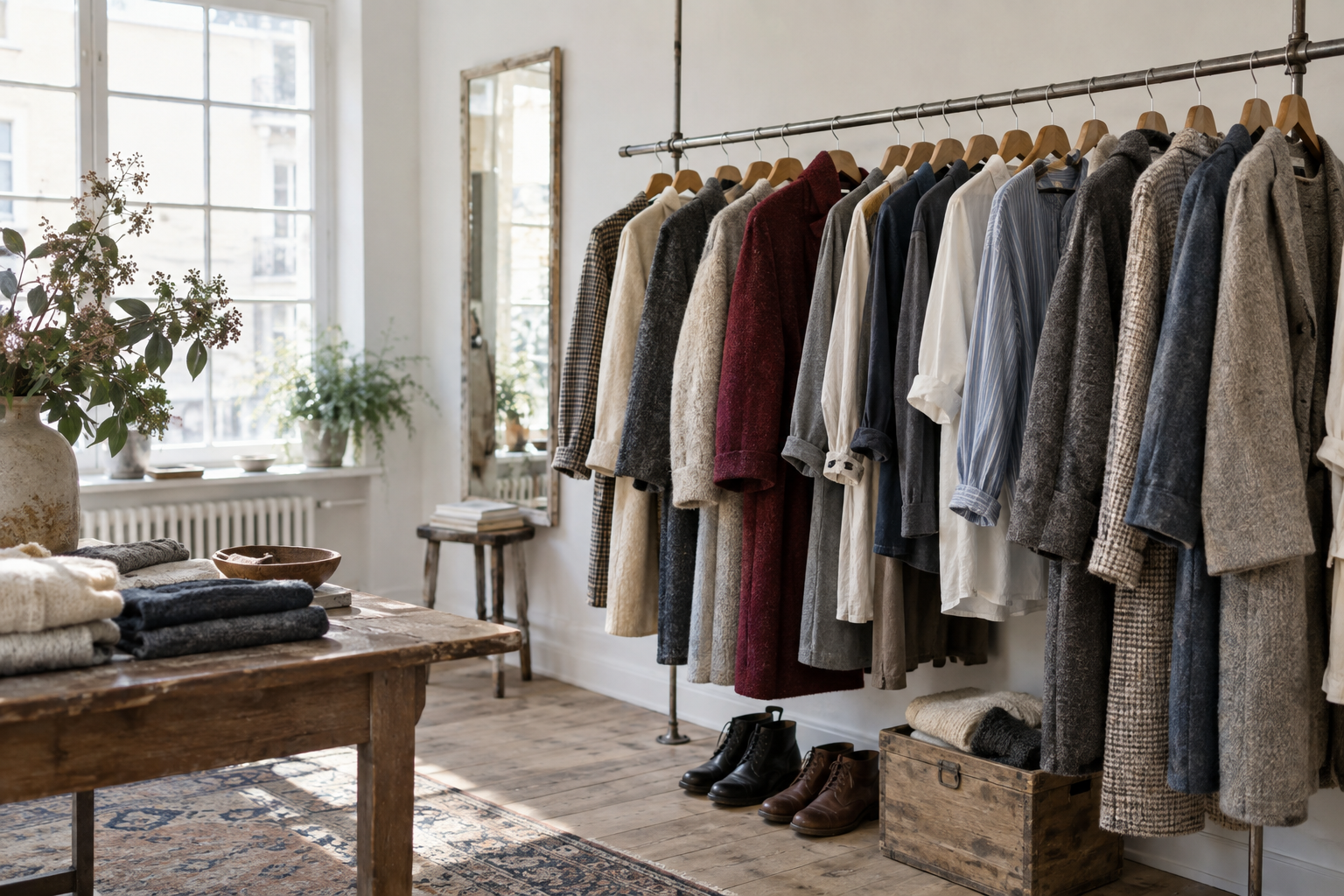
The most interesting piece in an outfit is sometimes the one you cannot immediately place. A jacket with an unfamiliar cut. A printed shirt that interrupts an otherwise simple wardrobe. A bag that looks better for having already lived a little. Vintage offers the pleasure of finding something that does not arrive with a complete set of instructions for how to wear it. In Stockholm, that pleasure has a geography: independent shops, neighbourhood walks and a stretch of Södermalm where secondhand becomes a way to spend an afternoon.
The sudden part is worth questioning
Stockholm did not discover vintage this season. Judits Second Hand describes a history of more than thirty years, and TIME included Hornsgatan’s Slow Fashion District in its World’s Greatest Places coverage in 2024. So the title asks a cultural question, rather than announcing a measured surge in shoppers. What makes older clothes feel relevant now? Our reading is that vintage brings together several appealing things: personal style, the satisfaction of discovery and a shopping experience with a strong sense of place. An established local culture can feel newly compelling when it offers something people are missing elsewhere.
A fashion district you can walk
The Slow Fashion District’s own guide puts Hornsgatan at its centre and describes around twenty shops, with a suggested loop of approximately three kilometres between the Slussen and Zinkensdamm areas. The mix reaches beyond clothing into interiors, accessories and redesign. A cluster like this changes the experience. You can compare different shopkeepers’ tastes, pause for coffee and let an unexpected window decide the next stop. Shopping becomes part of exploring Södermalm, with enough variety to make wandering worthwhile.
The appeal of something harder to repeat
A new collection offers a shared vocabulary: the same silhouette, the same colour, the same campaign. Vintage introduces less predictable material. A slightly unusual collar or a faded print can change the feeling of clothes you already own. It does not require dressing entirely in another decade. One older piece beside contemporary basics may be enough. The attraction is the small act of interpretation: deciding that something belongs in your wardrobe even when it was never designed with this season in mind. That is a different pleasure from knowing you have bought the right new thing.
Secondhand has more than one personality
Vintage and secondhand overlap, but they are not interchangeable. Secondhand describes previous ownership; vintage usually points to an older piece with a recognisable period or design character. Recent resale belongs in the conversation too. At Judits on Hornsgatan, clothes and accessories come through both private consignments and the shop’s own sourcing. At Slow Fashion Hub, Vintage Vitalité and Em’s Second Hand share a space with redesign practitioner Stina Loving. These different approaches matter: a shopper can be interested in contemporary labels, expressive older pieces or remade clothing without treating them as the same category.
A more personal Stockholm wardrobe
The familiar picture of Scandinavian dressing can feel narrowly prescribed: neutral colours, clean lines, everything apparently effortless. Vintage leaves room for a more individual version. Imagine a patterned blouse under a practical coat, a bright scarf against grey knitwear or an older jacket worn with everyday denim. These are styling possibilities, not a claim that Stockholm dresses as one. They suggest why secondhand fits so comfortably within a city associated with design: choosing proportion, texture and contrast can be as satisfying as choosing a label. Restraint and character can exist in the same outfit.
The find makes a good story
There is an obvious editorial reason vintage works well in pictures and short videos. A search has a beginning, an uncertain middle and, sometimes, a find. A shop rail, a close-up of a fabric and the finished outfit give a story something tangible to follow. That makes the subject well suited to Pinterest and TikTok, although it does not establish that Stockholm vintage is currently going viral. The more useful question for the person shopping is what happens after the photograph. Does the garment fit? Can you care for it? Will it become part of an ordinary Tuesday, as well as a memorable afternoon?
Let the afternoon stay unhurried
If you want to explore, use the district’s own map as a starting point and check individual shops before setting out. Leave space in the plan for browsing. Try unfamiliar shapes, look at seams and fastenings, and judge condition alongside price. An older label does not guarantee quality, and a rare piece is only useful if you actually want to wear it. There is no need to return with a bag from every stop. Sometimes the best result is a clearer sense of what you like; sometimes it is one piece that makes the rest of your wardrobe feel more like you.
What is worth bringing home
The strongest argument for vintage is not that everything old deserves another purchase. It is that something already here might deserve more attention. In Stockholm, the shops, the walk and the selection give that idea a particularly appealing setting. You can leave with an object and a memory attached to it: where you found it, what surprised you, why you chose it. Perhaps that is the lasting appeal. A wardrobe becomes more interesting when its pieces have been noticed, tried and lived in—not simply added.
Sources
Explore smaller wardrobes, personal style and the changing relationship with fashion’s constant newness.